
Keep the effort conversational. Alternate walking and easy running before adding speed, distance or race-day equipment.

MVMNTO · RUNNING ACADEMY
Build the run.
Keep the aura.
Four learning journeys. Arrive, learn, try, build, take it outside—and meet the community with more confidence.Choose a room ↓THE PROGRESSION TRACK
Start where you are.
Earn the next layer.
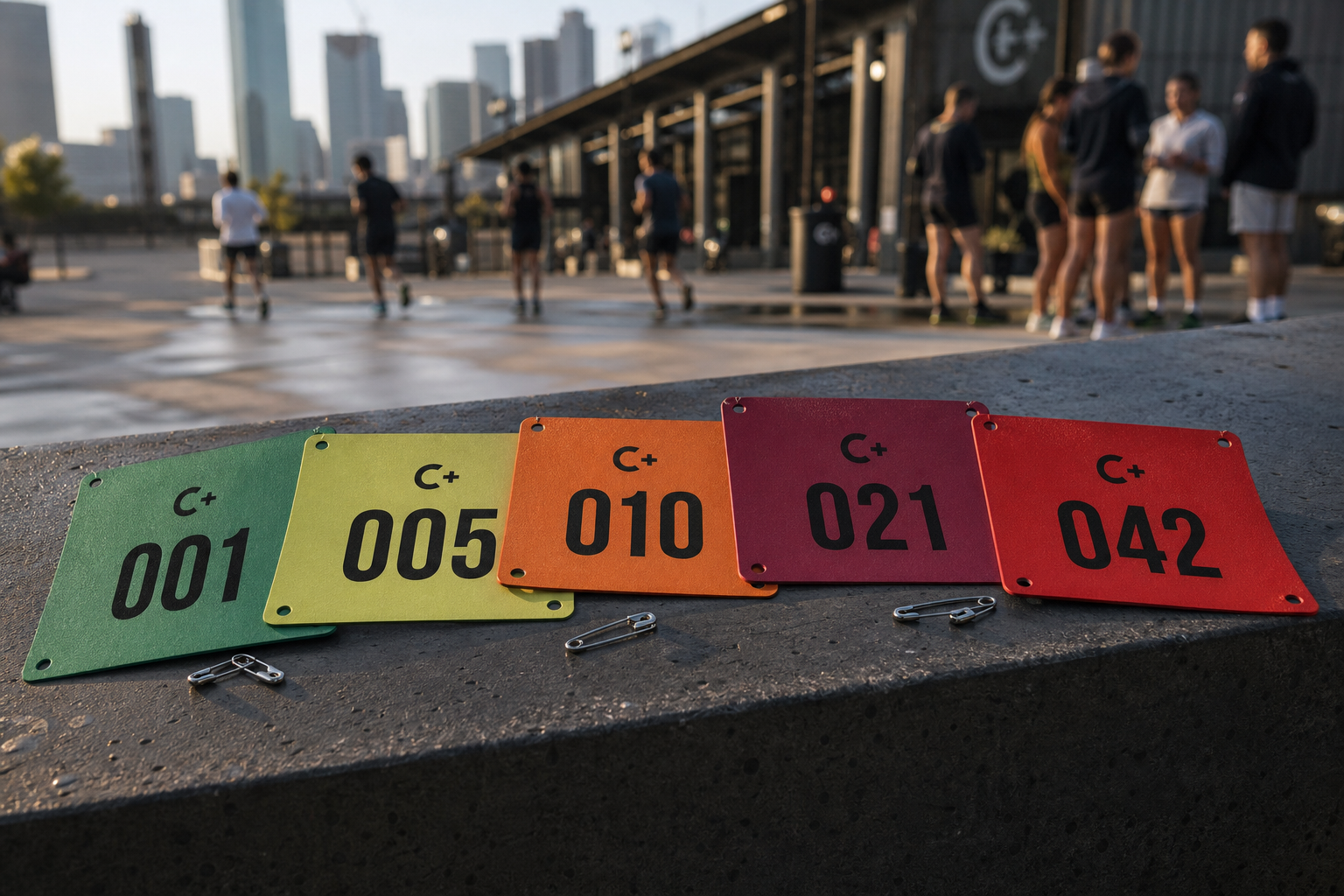
The color marks complexity—not worth. Green begins with walk-run rhythm; red means individualized coaching, race-day demands and consequences worth respecting.HOW TO ARRIVE
Prepare the runner,
not just the route.
Check heat, humidity, air quality, surface and daylight. Change the plan when conditions change the cost.
Notice pain, illness, unusual fatigue, dizziness or breathlessness before choosing intensity.
Use familiar shoes and clothing. Add hydration or fuel only when distance, heat and individual need make it useful.
Know the route, effort, turnaround and how you will stop. Hard sessions belong after a base—not before one.
THE 24-CARD RUNNER'S DECK
Choose a card.
Let the body learn.
Swipe sideways through Warm-Up, Recovery, Technique, and Strength + Elasticity. Practice stays visual and immediate; deeper Academy reading lives in its own section.01 · SWIPEMove sideways through the deck and choose one photograph.
02 · TAP THE MAPWe bring the posture map into view. Tap each numbered point for a cue and why it matters.
03 · BUILDAdd the card, choose a preset, then start the calm guided slideshow.
Choose a card above. Its posture map will open here.
POSTURE MAP · Tap a numbered point
BUILD AT BASECAMP
Choose the run.
We shape the sequence.
Keep this part simple: choose a ready-made sequence or add cards from the deck. Reorder, remove, then press play.1 Choose a preset or add cards2 Reorder with ↑ or remove with ×3 Begin the guided slideshow
Your sequence is empty. Choose a preset or add a lesson from the deck.
ESTIMATED CARD TIME0:00Walking or running time is separate
Music is optional and starts only when you choose it. Presets are educational examples, not individualized training plans. Progress gradually; use a qualified coach for plyometrics, speed, marathon or ultra preparation, injury history, or persistent symptoms.
ACADEMY · BOOK STUDY
Understand the why.
Then return to practice.
This is the reading room: purpose, modifications, possible benefits, precautions, gear and the source behind the lesson.- WHAT THIS MAY HELP
- POSTURE LANDMARKS
- POTENTIAL BENEFIT
- PRECAUTIONS
BREATH + EFFORT
Use the talk test.
Keep numbers in context.
Wearables can help, but medications, heat, fatigue and individual physiology change heart-rate responses. Begin with breath, speech and perceived effort.Conversation is effortless.
Breathing is calm enough for full sentences. Use this for warm-up, walk-run beginnings, easy recovery and most cooldowns.
RECOMMENDATIONStay here until the body feels more organized than when it began.THE RUNNER'S TOOLBELT
Train the runner.
Not only the miles.
Six evidence-aware learning tabs translate breathing, music, attention, effort, recovery and foot tools into experiments you can understand. Sources stay visible, and uncertain claims are named as uncertain.HARD · LET AIRFLOW ADAPTSTEADY · NOSE + MOUTH MAY SHAREEASY · COMFORTABLE RHYTHMRESET
FULL SENTENCES
FULL SENTENCES
EVIDENCE LENS · ADAPTABLE
There is no single perfect running breath.
At easy effort, nasal breathing may feel comfortable and can warm and humidify incoming air. As intensity rises, many runners naturally use the mouth or both nose and mouth to meet ventilation demand. Do not force a pattern that creates air hunger, panic, dizziness or poor mechanics.
- Easy: use the talk test; full sentences should fit.
- Steady: let airflow expand without making the breath a contest.
- Hard: breathing will be vigorous; the session—not a rigid inhale/exhale count—sets the demand.
CURRENT CARGA FREQUENCYOpen on Spotify ↗Use by feel—not as a forced cadence prescription.
30 MIN · EASYPlaylist in developmentWarm, social and conversational.
60 MIN · STEADYPlaylist in developmentConsistent energy without chasing every beat.
4 HR · LONG RUNPlaylist in developmentLong-form arcs, quiet pockets and late-run lift.
EVIDENCE LENS · USEFUL, INDIVIDUAL
Music can shape feeling and effort.
A large meta-analysis found music was associated with more positive feelings, lower perceived exertion and small-to-moderate performance effects across exercise contexts. Faster music was not automatically better for every runner or every session.
Tempo may nudge step rhythm, but there is no universal “ideal BPM.” A deliberate cadence change can alter biomechanics and may initially feel awkward or cost more energy. Use it as a coached experiment—not a number to chase.
Meta-analysis · music in exercise and sport ↗Systematic review · changing running step rate ↗NEARROUTEHORIZON
EVIDENCE LENS · ATTENTION, NOT MAGIC
Look where the run is unfolding.
A relaxed forward gaze can support route reading, posture and awareness of people, traffic and surface changes. In one treadmill study, trained runners used less oxygen at the same speed while focusing on their surroundings than while focusing internally on movement or breathing.
This does not mean a fixed gaze creates runner's high. Runner's high is variable and still being studied; human evidence links endurance exercise with endocannabinoid changes, but reliable proof of a single cause remains incomplete.
TRY ITSoften the eyes. Scan near enough to read the surface, then widen attention toward the route. In technical or crowded spaces, safety takes priority over flow.
Study · attentional focus and running economy ↗Systematic review · runner's high and endocannabinoids ↗1MOVE EASY
2FULL SENTENCES
3REFUEL BY NEED
4ADAPT, THEN LOAD
EVIDENCE LENS · CONTEXT MATTERS
Zone 2 is easy running—not literal rest.
Use full-sentence speech and perceived effort alongside wearable data. Heat, medications, fatigue and individual physiology can shift heart rate. Recovery is the time in which adaptation happens; sleep, nutrition, hydration and sensible spacing matter more than one gadget.
Lactate is not simply toxic waste and does not explain next-day soreness. Easy movement can change blood lactate clearance after hard work, but that is not the same as guaranteeing less soreness or preventing injury.
CDC · talk test and intensity ↗World Athletics · recovery and adaptation ↗BAREFOOT TRIPODLearn heel, big-toe base and little-toe base contact.
HALF CYLINDERA stable edge for low-level calf and balance variations.
BALANCE BOARDOptional instability; begin near support and stop before quality fades.
TOE SPACERSComfort tool for some people—not a universal alignment fix.
BANDSimple resistance for ankle and hip control.
CLINICIANThe right tool for persistent pain, instability, numbness or recurrent injury.
EVIDENCE LENS · OPTIONAL TOOLS
Build capacity before buying complexity.
Foot-muscle exercises may improve some measures of foot function and balance, while balance training has clearer support in certain athletic and chronic-ankle-instability settings. That does not prove every board, wedge or spacer prevents running injuries.
Toe-separator research is mainly about specific foot conditions such as hallux valgus, with inconsistent methods and a need for more research. Comfort is a reasonable test; pain, tingling, color change or forced positioning is a reason to stop.
Meta-analysis · intrinsic foot muscle training ↗Systematic review · toe separators ↗Systematic review · balance and ankle instability ↗STRONGERSystematic reviews, public-health guidance and repeated findings.
USE WITH CONTEXTEvidence exists, but population, dose or outcome may not match every runner.
EXPERIMENTALPlausible or popular; not established as an injury-prevention promise.
HOW CARGA+ BUILDS TRUST
The source belongs beside the lesson.
Each Academy card and Toolbelt tab links to the institution, guideline, study or review supporting its claim. When research is mixed, indirect or limited, the copy says so. Scientific references support general education; they do not turn a web lesson into diagnosis or individualized care.
Houston resources are included where relevant, alongside public-health guidance and peer-reviewed international research.
Baylor College of Medicine · sports medicine ↗UTHealth Houston · sports medicine ↗UTHealth Houston · marathon preparation ↗GENERAL EDUCATION · Not medical advice, diagnosis or a personalized training plan. Choose a comfortable range, progress gradually, and consult an appropriate clinician or qualified coach for symptoms, injury history, medical conditions, pregnancy, or higher-intensity training.
Train with context.
Dynamic preparation, gradual progression, the talk test and symptom awareness anchor the academy. Stop and seek appropriate care for chest discomfort, fainting, severe or unusual shortness of breath, sudden weakness, or symptoms that feel wrong for you.
MVMNTO ACADEMY · SELF-GUIDED LEARNING
Watch, Read & Explore
See the technique. Understand the ideas. Bring what you learn into your own practice.
Explore credited demonstrations, recommended books, and further references at your own pace.
Running & Warm-ups
01 · Watch
Running warm-ups & cool-downs · Bupa Health
Watch on YouTube ↗02 · Read
Running Anatomy · Joe Puleo & Patrick Milroy
Anatomy and strength exercises to support your understanding of running.
Explore the book ↗03 · Sources & context
Understand the practice.
Running warm-up and cool-down videos · Bupa ↗Selected learning references. Videos and books belong to their credited creators.
External resources supplement your learning; they do not imply a partnership or endorsement. Choose movements appropriate to you and follow the source’s instructions.