
Reach + waterfall
Rise through an easy reach, then soften the knees and let the torso fold only as far as feels spacious.

GAYO · THE HOUSE AT DAWN
A quiet architecture for movement, breath and attention. Leave your slippers at the door. Enter with respect. Learn with curiosity. Practice with care.
Arrive at the breathROOM 01 · RESTORE · WINTER STILLNESS
Restoration gathers the practices that help attention soften without making promises the body cannot keep. Begin with an extended exhale, choose gentle movement, then meet the prop or teacher that offers the right kind of support.
A comfortable longer exhale helps set the room’s pace: unhurried, quiet and never forced.
RESTORE RECIPE · GENTLE MOVEMENT DECK
Move through these cards in any comfortable order. Keep the range easy, the breath available and the floor or a chair close enough to offer support.
Rise through an easy reach, then soften the knees and let the torso fold only as far as feels spacious.
Let the arms trace a relaxed diagonal while the ribs and hips turn together—small is welcome.
With feet supported, explore a barely-there pulse. Choose stillness if bouncing is not right today.
Invite softness through hands, shoulders and legs without chasing a release or forcing sensation.
Turn from the whole body with a quiet jaw. A seated version offers another clear doorway.
Draw smooth circles that leave the shoulders and breath unstrained; reverse when ready.
RESTORE RECIPE · TAP + NOTICE ATLAS
Choose a region to compare three lenses: nearby anatomy, a traditional Chinese medicine channel reference, and a simple reflective cue. Gentle tapping may offer sensory input and invite movement; it is not manual lymph drainage or proof that a meridian was blocked.
Regular hydration supports normal body function, and movement creates mechanical changes in muscle and connective tissue. Current evidence does not establish that drinking water exactly 30 minutes before practice instantly liquefies fascia or “unknots” tissue. Arrive normally hydrated, sip according to thirst and medical guidance, and let pressure remain comfortable.
ROOM 02 · YOGA · THE PRACTICE DECK
Explore a GAYO-curated mix of postures drawn from Power/Vinyasa, Ashtanga, Hot Yoga, Yin and Restorative practice. This is a library—not a branded sequence. Choose a card, then open its alignment map, breath cue and ways to make the shape meet you.
A softly audible, even rhythm can support attention and pacing through movement. The sound comes from subtlety—not squeezing.
A SMALL MOVEMENT BREAK
Choose a clear space and keep a stable chair nearby. Each photo shows one phase of a moving exercise; follow the written pathway and stay within an easy range.
Body focus describes the movement skills you practice, rather than a promise to treat pain or a health condition. Props are invitations to make the exercise fit you.
SCROLL THE DECK · SELECT A CARD TO OPEN THE PRACTICE
Tadasana
PURPOSE + POTENTIAL BENEFIT
Stand alert without becoming rigid.
These are learning invitations, not a test of one “perfect” shape. Let comfort, breath and qualified teaching guide your range.
YOUR GAYO FLOW
Select postures from the library, choose how long to stay and launch a guided sequence with pose, breath and time visible.
This is a personal learning tool, not an official Journey Into Power, Bikram/26+2, Ashtanga, Yin or Restorative sequence. Begin gently and ask a qualified teacher to review ambitious combinations.
PRACTICE LIBRARY
Each card can point to an attributed teacher demonstration or an exact timestamp inside a public sequence. GAYO curates the doorway; the teacher retains authorship of the lesson.
INTEGRATE · OFF THE MAT
Name one moment when effort became gripping.
Keep one posture, breath cue or supported variation for tomorrow.
Practice steadiness during one ordinary transition—standing up, waiting or walking.
RESTORE RECIPE · INTEGRATE
What feels more available: breath, range, warmth, quiet—or simply choice?
Select one two-minute movement or one supportive tool for your next pause.
Place the pause before the moment you usually wait until exhaustion.
RESTORE RECIPE · PRACTICE LIBRARY
Follow complete, attributed practices when you want pacing, transitions and context beyond an individual card.

THE EIGHT BROCADES COURTYARD
Ba Duan Jin is a Chinese Qigong practice traditionally explored as eight coordinated movements. Enter slowly, one brocade at a time, with Mimi Kuo-Deemer as the trusted guide.
Practice with Mimi Kuo-Deemer ↗RESTORE RECIPE · THE EIGHT BROCADES DECK
Scroll through the complete Ba Duan Jin movement family. Each card offers a learning intention—not a substitute for the pacing, transitions and cultural context of teacher-led practice.
Lengthen upward while keeping the stance grounded and the shoulders responsive.
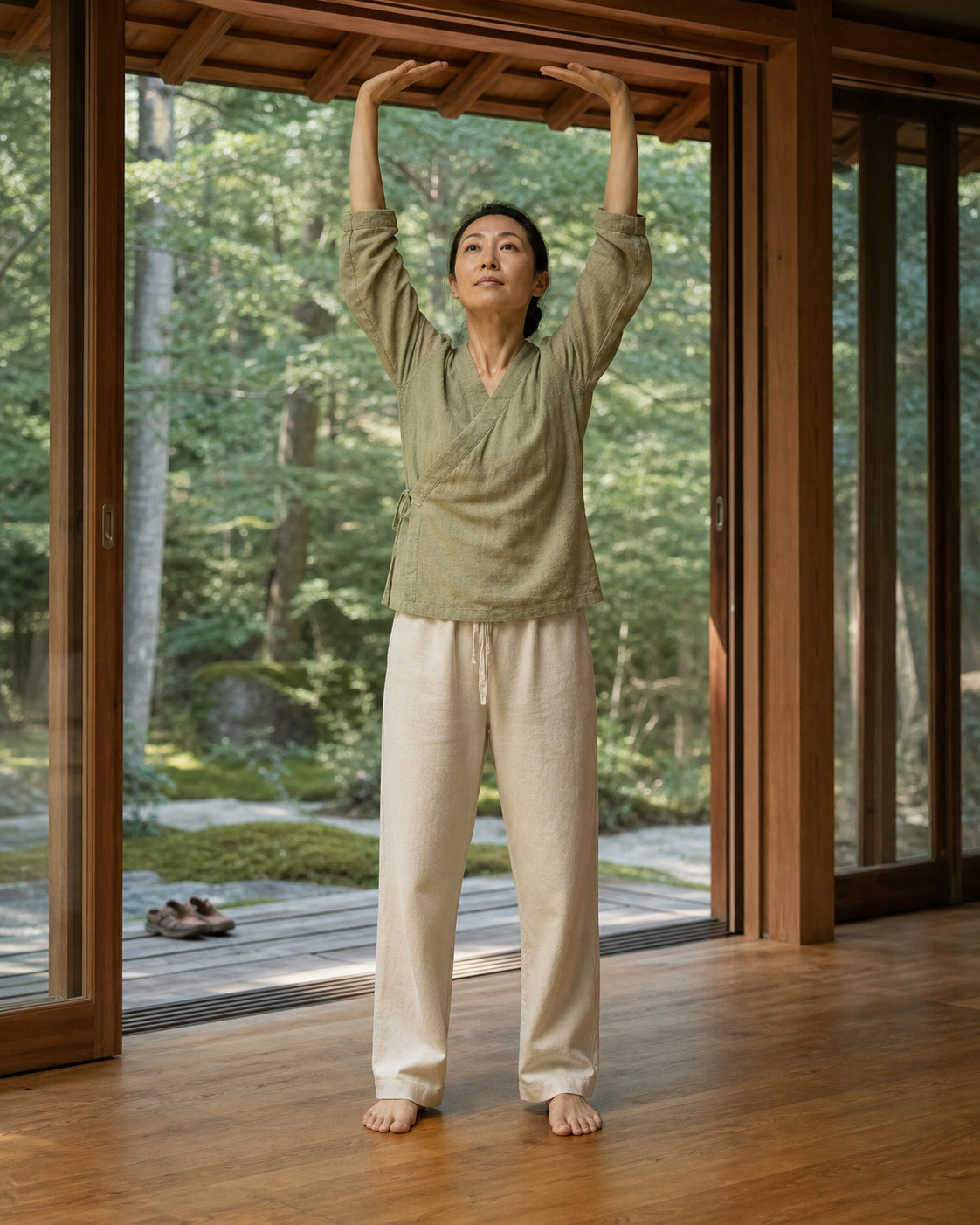
Interlace or softly connect the hands, turn the palms upward and lengthen overhead; lower with the same unhurried attention.
BREATHLet the inhale accompany the rise and the exhale accompany the return, unless your teacher offers a different rhythm.
POSTUREFeet grounded, knees soft, ribs responsive and shoulders away from the ears.
EASIERKeep the hands apart or lift only to a comfortable height.
TRADITION + CARETraditionally explored as an opening and lengthening movement. Do not force the shoulders, neck or breath.
Study the complete sequence with Mimi ↗Coordinate the gaze, hands and shifting stance without hardening the breath.
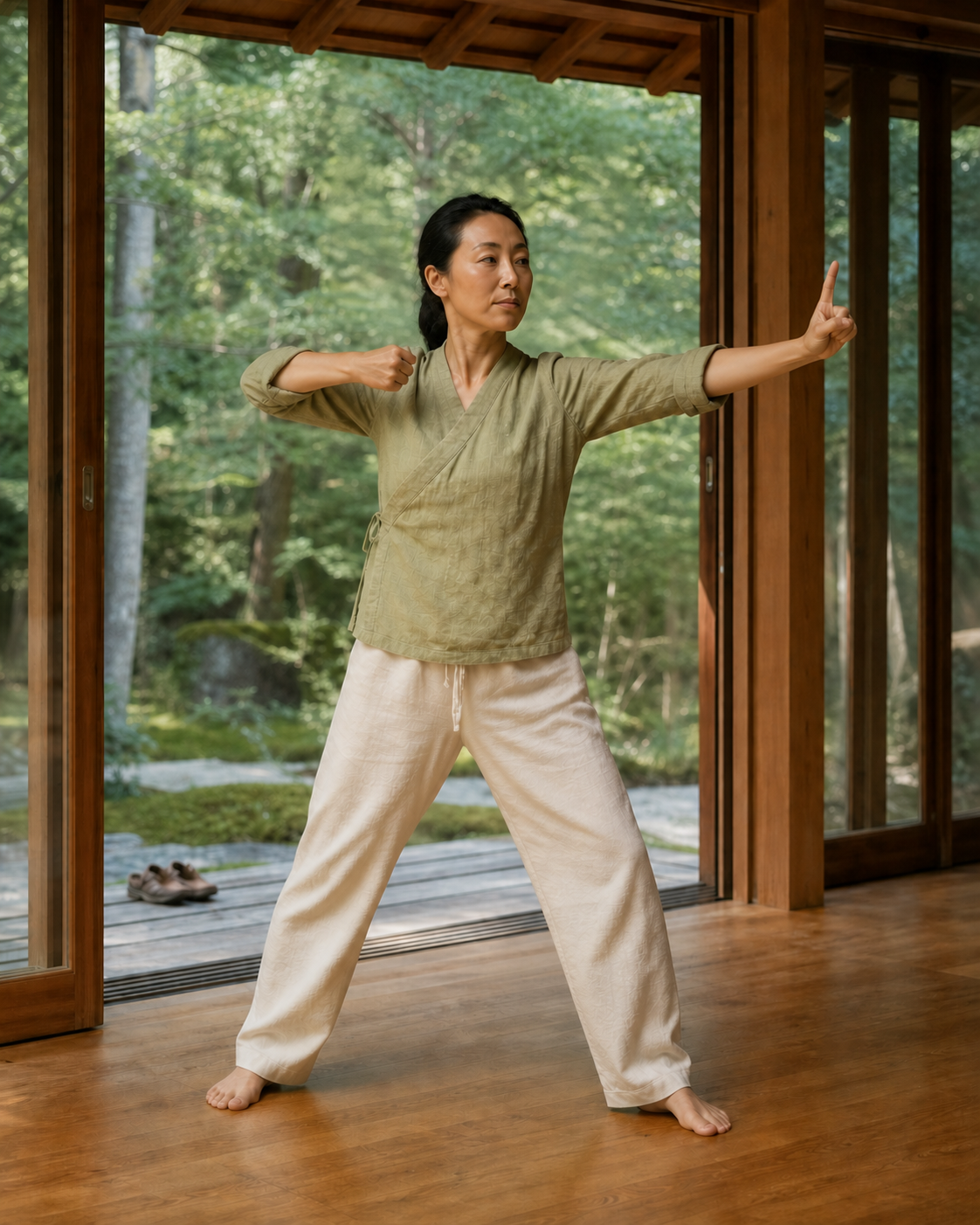
Settle into a wide stance. Extend the sighting hand with the index finger raised while the other hand draws toward the shoulder; alternate sides.
BREATHLet the inhale prepare at center and the exhale accompany the opening without strain.
POSTUREKnees follow the toes, pelvis stays centered, gaze follows the extended hand and shoulders remain low.
EASIERUse a higher stance and a smaller draw.
TRADITION + CARETraditionally explores focus, coordination and grounded strength. Reduce range for knee, shoulder or balance concerns.
Study the complete sequence with Mimi ↗Explore opposing directions without hardening.
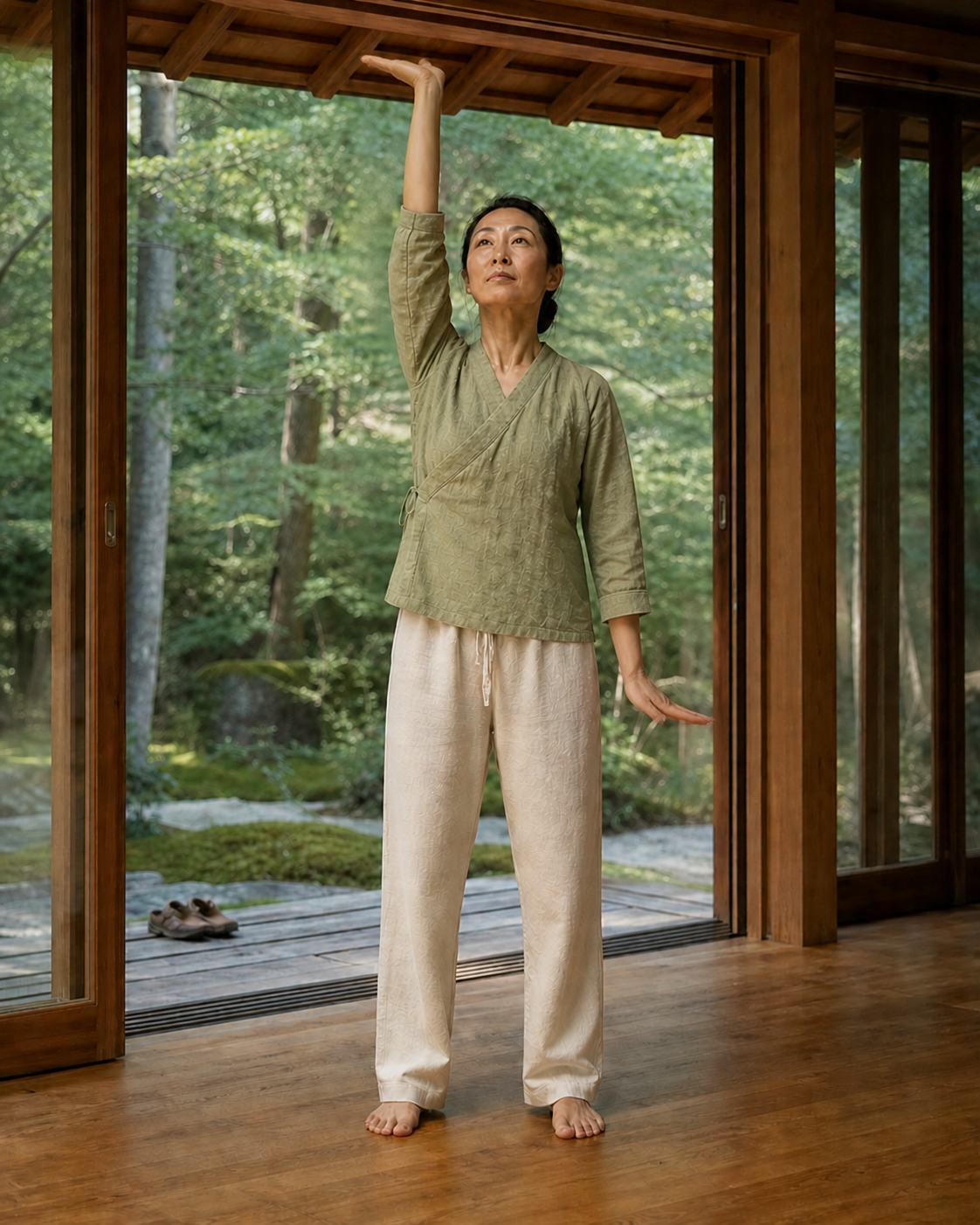
From center, one palm presses upward while the other presses downward; return and change sides.
BREATHInhale toward center and exhale as the palms move in opposite directions.
POSTUREUpper palm faces sky, lower palm faces earth, elbows stay responsive and the torso remains upright.
EASIERKeep both hands below shoulder height.
TRADITION + CARETraditionally explores opposing directions and whole-body coordination. Avoid forcing the upper shoulder.
Study the complete sequence with Mimi ↗Turn with spaciousness through the eyes, neck and torso.
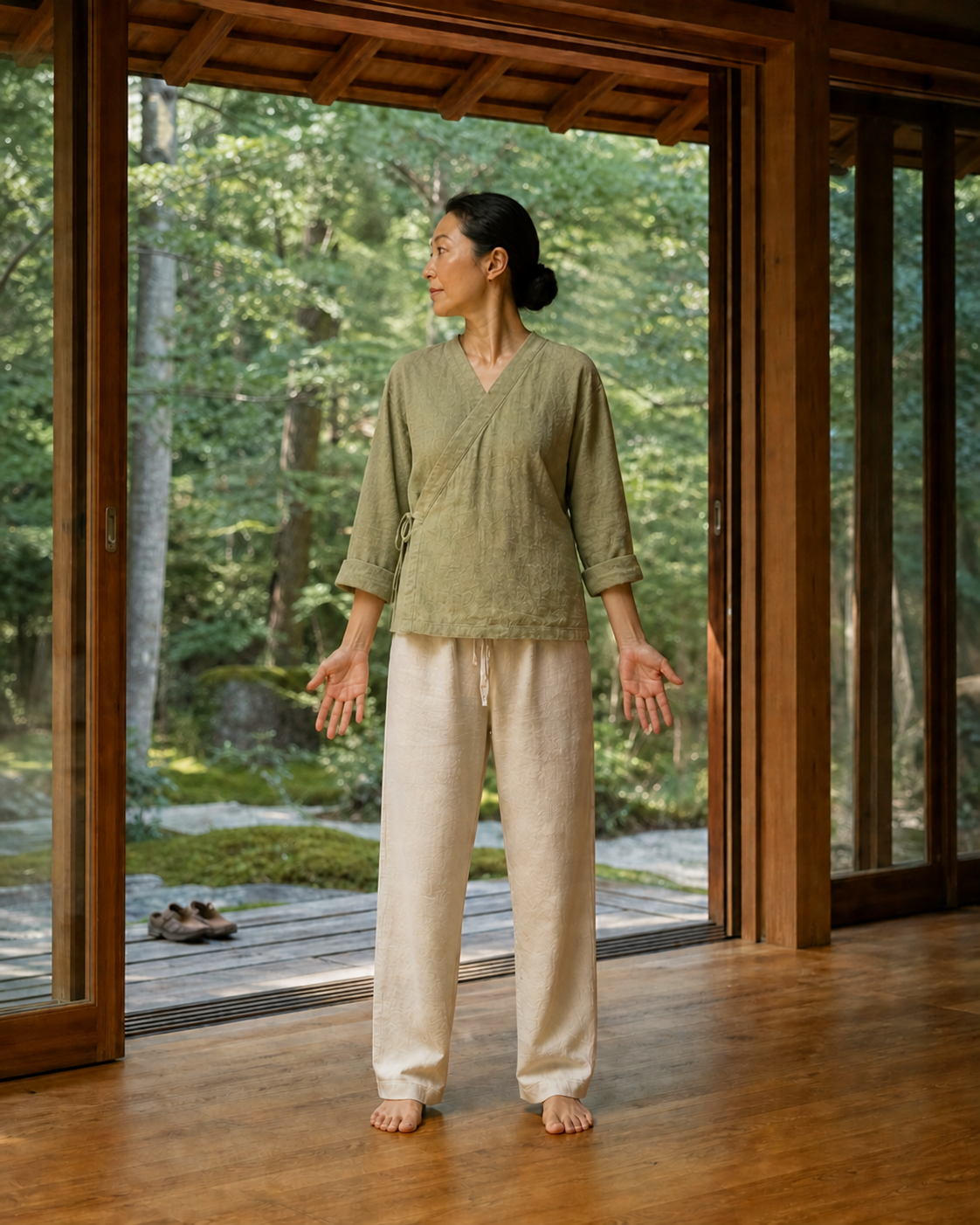
Lengthen through the crown, open both palms outward and slowly look over one shoulder; return through center and alternate.
BREATHInhale at center and exhale into the comfortable turn.
POSTUREPalms rotate outward, collarbones stay broad and the turn remains smooth rather than pulled.
EASIERMove only the eyes and head through a smaller range.
TRADITION + CARETraditionally explores looking back with calm attention. Stop for dizziness, pain or nerve symptoms.
Study the complete sequence with Mimi ↗Let the hands support a patient circular pathway.
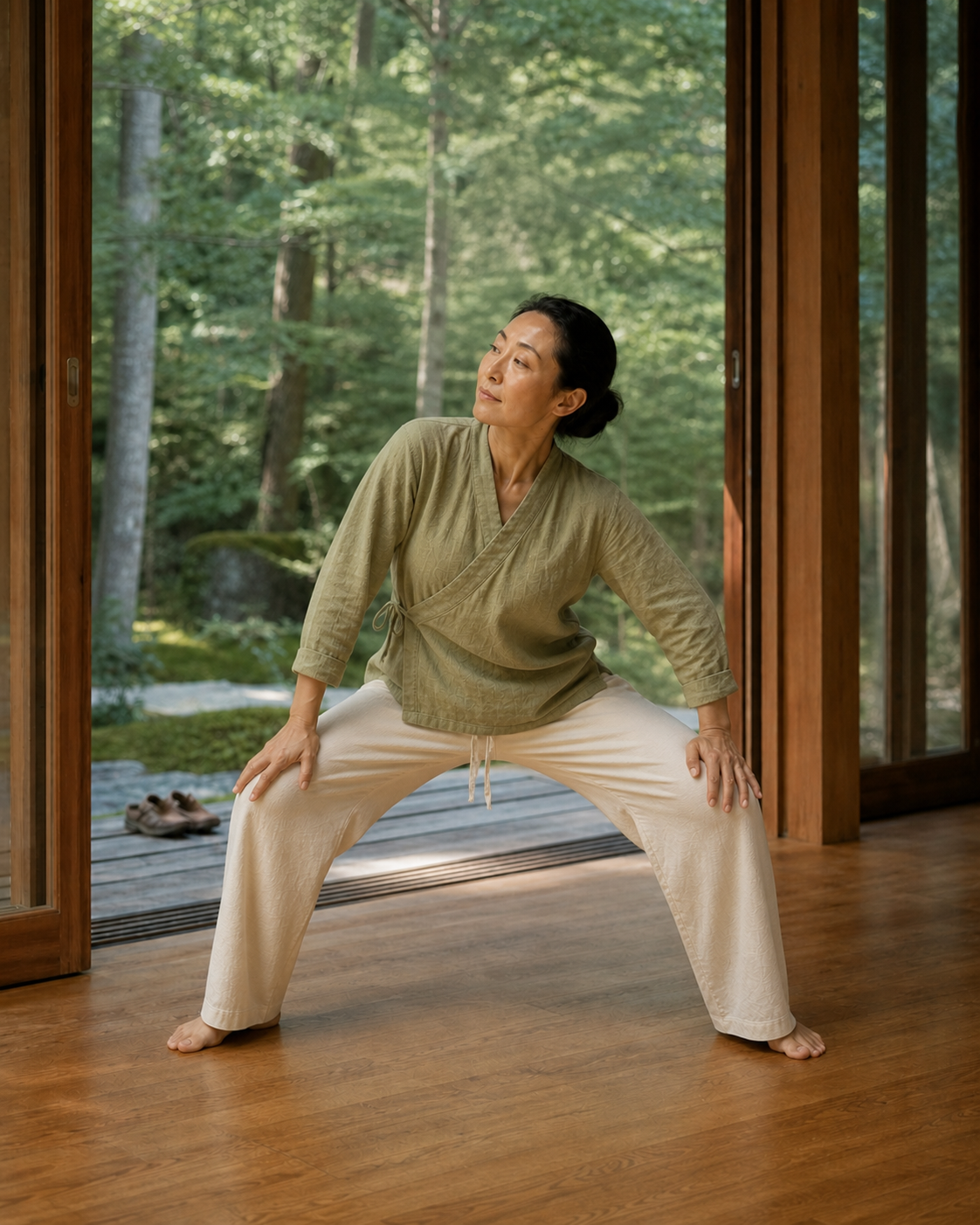
Set a wide stance, place hands close to the knees and trace the torso through a controlled circular pathway before changing direction.
BREATHKeep the breath continuous; allow an easy exhale through the deepest part rather than holding.
POSTUREKnees follow toes, hands support the thighs near the knees and head and tail counterbalance without collapsing the spine.
EASIERUse a higher stance and a much smaller circle.
TRADITION + CARETraditionally explores coordinated circular movement. Avoid deep range with knee, hip, back or balance concerns.
Study the complete sequence with Mimi ↗Fold and return through a comfortable range.
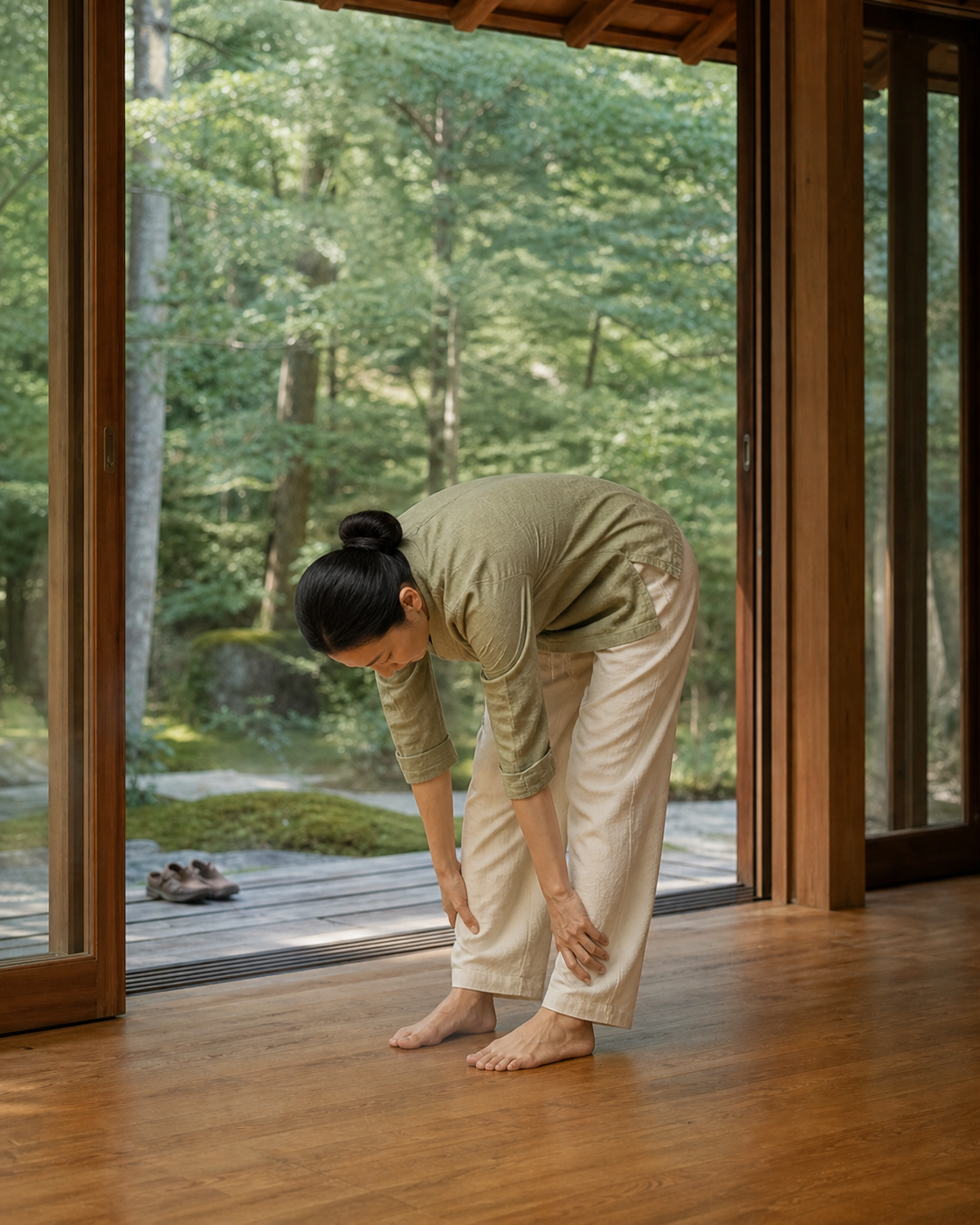
Lengthen upward, then fold along the legs only as far as the spine, knees and breath remain comfortable; return slowly.
BREATHExhale into the fold and inhale as the body rises without rushing.
POSTUREKnees may bend, neck stays easy and the return begins through the legs and hips.
EASIERSlide hands only to thighs or shins.
TRADITION + CARETraditionally explores the back-body pathway. Avoid deep folding with dizziness, acute back pain or medical restrictions.
Study the complete sequence with Mimi ↗Gather clear strength without hardening the breath.
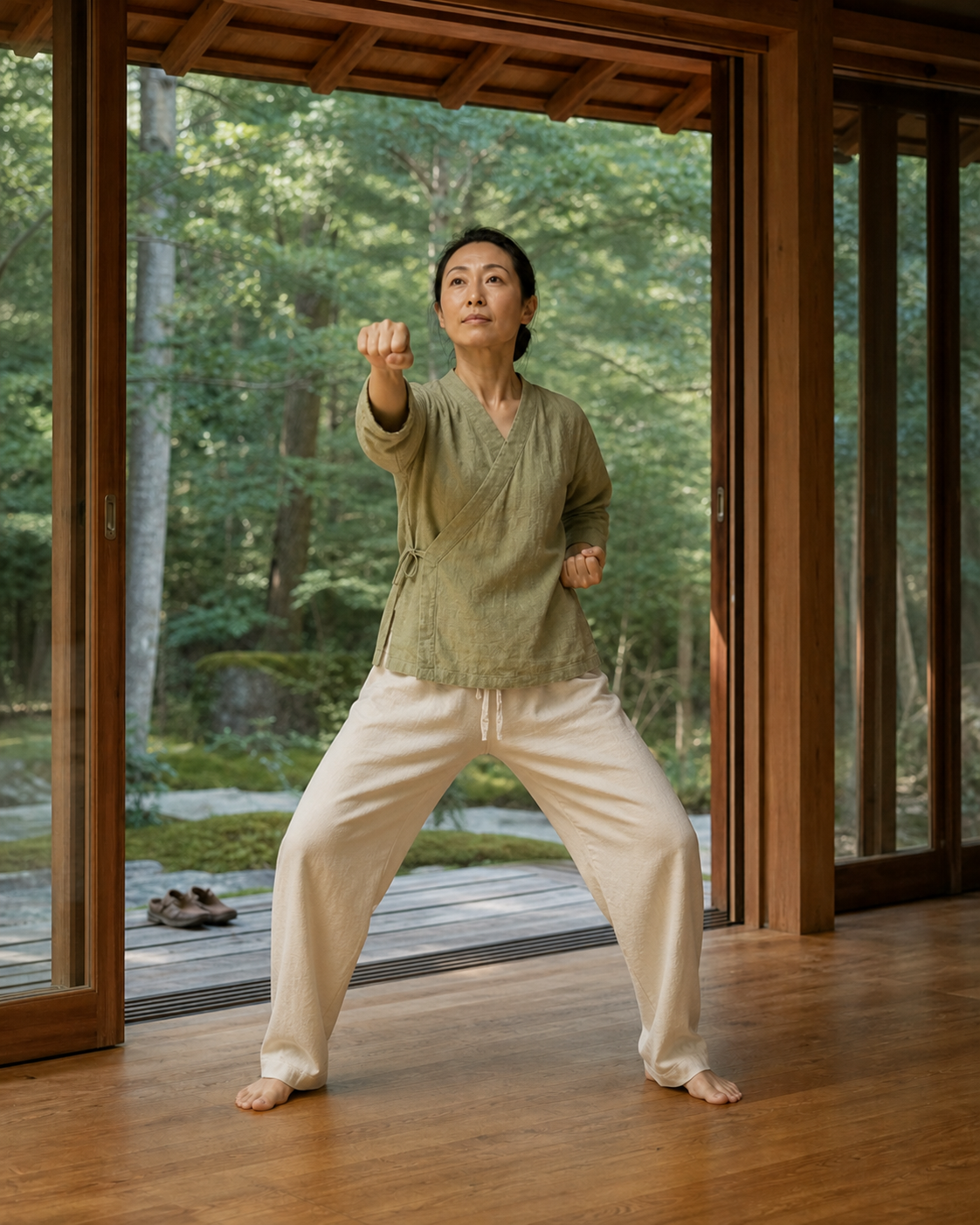
From a grounded stance, extend one controlled fist while the other gathers near the waist; return and alternate.
BREATHExhale through the extension and inhale on the return.
POSTUREWrist stays aligned, shoulders remain low and the alert gaze does not become facial gripping.
EASIERUse open hands, a higher stance or a shorter reach.
TRADITION + CARETraditionally explores focused strength. Do not lock the elbow or turn the movement into a forceful strike.
Study the complete sequence with Mimi ↗Rise and settle with lightness and balance.

Rise lightly through the heels, pause in balance and settle with control; repeat only while the landing remains quiet.
BREATHInhale to rise and exhale to settle.
POSTUREBody stays tall, ankles aligned and weight shared across the forefoot.
EASIERKeep the heels grounded and rehearse the upward intention.
TRADITION + CARETraditionally closes the set with a light settling action. Use support or keep the heels down for balance, foot or calf concerns.
Study the complete sequence with Mimi ↗Names and translations vary across teachers and lineages. Learn the full sequence with a qualified teacher before treating the cards as a stand-alone practice.
THE BREATH RING STUDIO
Each ring holds a different quality and level of support. Larger means more active or more teacher-guided—not better. Select one to let the ring become the breath.
A quiet rhythm that gives the exhale a little more room.
Keep every breath comfortable and unforced. Stop if you feel dizzy, strained or short of breath. Active practices belong in qualified, supportive spaces.
RESTORE RECIPE · KNOW YOUR TOOLKIT
Explore a block, strap, fascia ball or roller as support—not as a promise to fix, detox or force change.
Tools can change feedback, support and challenge. They do not diagnose, repair or “detox” the body. Stop with pain, numbness, dizziness or unusual symptoms.
RESTORE RECIPE · ROLLER + BALL BODY MAP
Select a highlighted zone to see a conservative placement, a support option and a breath cue. These are broad muscle areas—not scientifically fixed “trigger points,” diagnoses or promises of release.

BACK VIEW · Select a highlighted corridor
Keep tools on soft tissue—not bones, joints or the lumbar spine. Stop with sharp pain, tingling, numbness, weakness, sudden swelling or increasing symptoms. Ask a clinician first with an acute injury, fracture, torn muscle, vascular condition, unexplained swelling or persistent pain.
ROOM 03 · MAT PILATES · SPRING PRECISION
Each room follows the same learning recipe. Begin with lateral rib breathing, study one foundation at a time, choose only the tools that clarify the work, then continue with a trusted teacher.
Let the inhale widen the side and back ribs; exhale through softly pursed lips as the center gathers without gripping.
Rest the feet and let the inhale widen the side and back ribs before adding movement.
Explore a small, comfortable pelvic pathway without pressing the spine flat or gripping.
Press through the feet and lift only as high as the breath, neck and hamstrings remain easy.
Float one foot at a time or slide the heel along the mat while the trunk stays responsive.
Reach the arms through a clear arc without lifting the ribs or tightening the jaw.
Use a small range and a pillow under the head; let the waist stay long rather than rigid.
Grow tall on the inhale and turn gently on the exhale without forcing the end range.
Return to an easy position and notice what changed before deciding what comes next.
Mat · light resistance band · small hand weights · gliding discs
Tools add feedback or load. They are optional, and more resistance is not automatically more effective.
PRACTICE LIBRARY
Use a complete, teacher-led beginner practice to understand pacing and transitions beyond an isolated card.
INTEGRATE · EVERYDAY CONTROL
Find one daily task where you hold your breath or rush the return.
Use the lightest version that preserves coordination and an easy jaw.
Pair one full exhale with lifting, carrying or rising from a chair.
ROOM 04 · SOUND + REFLECTION · AUTUMN DUSK
This room holds breath, silence, symbolic chakra study and music as contemplative companions—not diagnosis or medical frequency treatment.
An easy, even count offers attention a quiet metronome before silence, humming or listening.
Grounding · LAM · contemporary pairing 396 Hz
Flow · VAM · contemporary pairing 417 Hz
Agency · RAM · contemporary pairing 528 Hz
Relationship · YAM · contemporary pairing 639 Hz
Expression · HAM · contemporary pairing 741 Hz
Discernment · OM · contemporary pairing 852 Hz
Meaning · silence · contemporary pairing 963 Hz
Comfortable seat · headphones at a safe level · journal · timer · permission to choose silence
Seed syllables and chakra systems vary by lineage. Rainbow colors and fixed Hz pairings are modern overlays, not universally ancient or medically established treatments.
LISTENING LIBRARY
Frequency and meditation playlists will live here once the official GAYO Spotify playlist links are connected.
INTEGRATE · LISTENING RITUAL
Observe the difference between sound, silence and the story you attach to each.
Select one track, seed sound or minute of silence—without assigning it a medical promise.
Journal one sentence about what you heard internally and externally.
MVMNTO ACADEMY · SELF-GUIDED LEARNING
See the technique. Understand the ideas. Bring what you learn into your own practice.
Explore credited demonstrations, recommended books, and further references at your own pace.
01 · Watch
Browse the creator’s credited YouTube demonstrations.
Watch on YouTube ↗02 · Read
An illustrated reference for understanding the muscles involved in stretching.
Explore the book ↗03 · Sources & context
Selected learning references. Videos and books belong to their credited creators.
External resources supplement your learning; they do not imply a partnership or endorsement. Choose movements appropriate to you and follow the source’s instructions.